Field test
We drove it around Montreal. Here is exactly what it did.
This page carries two different things, and the difference matters. The detection, tracking and plate reading below are from our own vehicle on public roads in Montreal, August 2026. The mismatch section is a demonstration of the comparison logic on public-domain reference footage against a test registry, because we have not yet had access to live registration data. Every box, track ID, make/model read and plate is a live model output either way. No re-runs, no cherry-picked frames, no touch-ups.
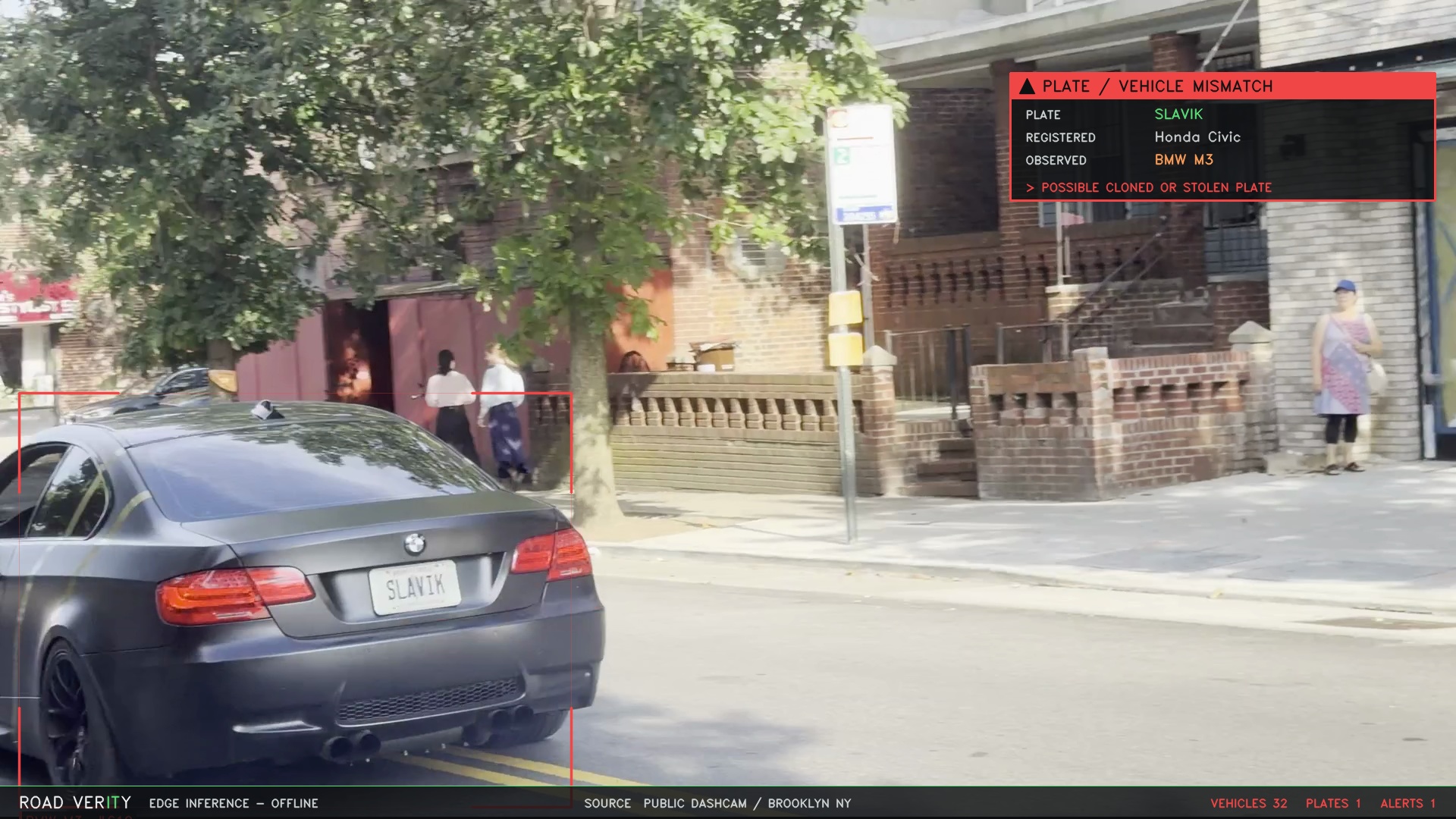
The comparison, demonstrated
This one is not our footage. It is public-domain reference video run against a test registry, because live registration data is exactly what we do not yet have. It shows the mechanism working end to end; it is not a field result.
A matte-black coupe passes the camera. AMVIS reads the vehicle as a BMW 328i and lifts its plate, SLAVIK. That plate is on file as a Honda Civic. The registration and the car disagree, so AMVIS raises a cloned-plate alert, entirely on-device. A plate-only reader would have waved this car through.
Reading a whole street at once
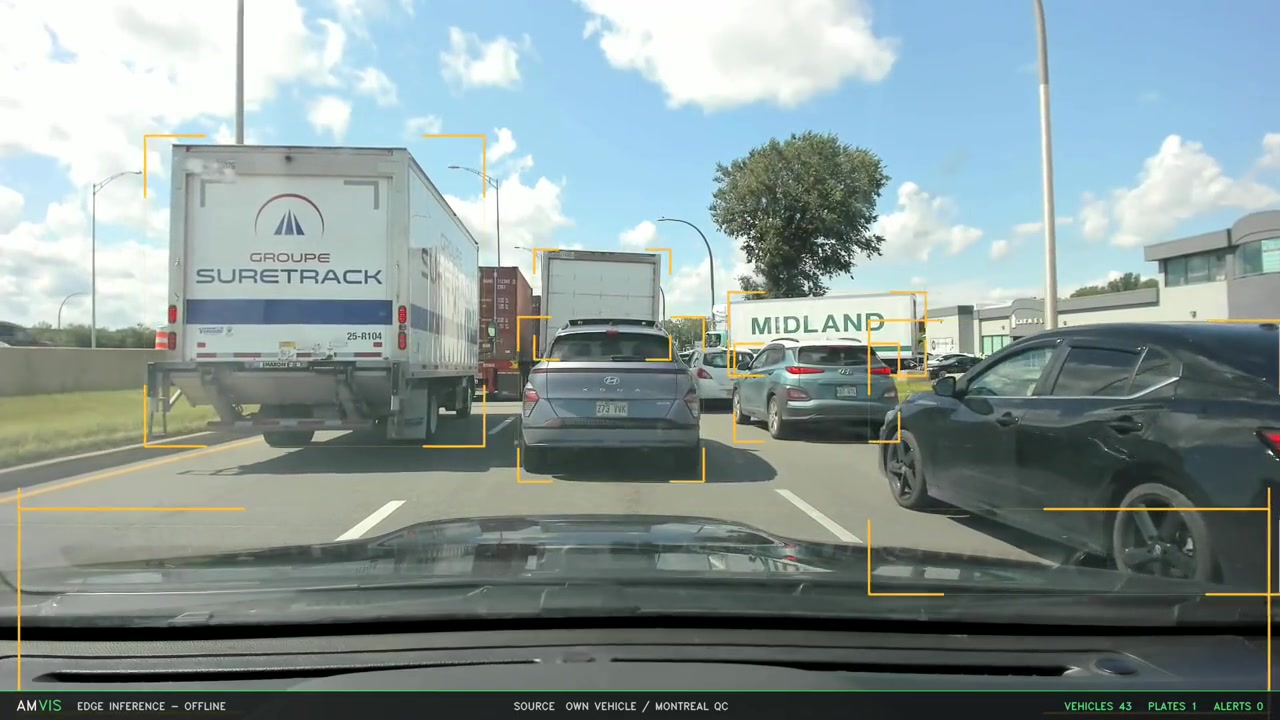
In a single frame the system holds dozens of vehicles, tracks each one, and labels the ones it can identify with confidence. Vehicles it cannot name stay as plain reticles rather than being guessed at.
How the pipeline runs
- 01
Detect
YOLOv8 finds every vehicle in frame.
- 02
Track
ByteTrack assigns a stable ID so each car is read once, not every frame.
- 03
Identify
An EfficientNet-B4 classifier trained on VMMRdb (8,949 make/model/year classes) reads the actual vehicle.
- 04
Read the plate
A plate localizer crops the plate; an ONNX OCR model lifts the characters.
- 05
Cross-check
The plate's registered make/model is compared to what the camera sees. Disagreement fires an alert.
What is real, and what is representative
- Every detection, track, make/model, and plate read is a genuine model output on real, unstaged footage.
- The registration record behind the plate is a seeded stand-in for an agency’s vehicle database. The cross-check logic that produces the alert is the real product logic.
- This clip came from a single consumer dashcam. Plate-read range and make/model accuracy improve markedly with the dual colour + infrared camera pair AMVIS installs.
- It was processed on a general-purpose computer, not the in-vehicle NVIDIA Jetson unit, which runs the same models in real time.
Want to see it on your own roads? We install it free for six months.
Request a pilot